Meanwhile, back between the Tigris and Euphrates, the Amorites have settled in to their role as lords of the land. But they live in dual worlds, one with the cities, and one with their own people. It is a difficult balance, because while they may be kings of Akkad, they are still chiefs of the warrior bands that follow them, whom they must keep happy. With a steady income of bribes, the warrior Amorites form a kind of leisure class, since they’ve largely nothing to do with the institutions of urban infrastructure. “Let the little city dwellers live under their roofs and tend their farms, so long as we are paid!” This attitude keeps the Amorites separate from their servants in blood as well as culture. As such, the Sumerians are pleased to continue living as they always have, since those few Amorites who do prefer city-life quickly acclimate themselves and disappear.
The union of the Amorites and the Sumerians, however, is not entirely out of the question. The kings of Akkad find it troublesome to please their followers, so steps must be taken to prove themselves supreme rulers. What laws already exist are codified by one Hamurabbi, who, in the Eighteenth Century BC, has the legal code etched into small obelisks and erected in the public place of every town. These laws apply to everyone, so in one move the king has made himself supreme and brought all his peoples – nomad and settled – to the same level.
Half the world away, sea-folk with a strikingly Egyptian-like culture have founded civilizations on Crete and the Aegean coasts in Greece and Ionia. A warlike people, they produce and export weapons to their mainland neighbors – likely the traders along the Palestinian and Phoenician coasts. But despite their warlike tendencies, they are nonetheless extremely advanced (for the age), indulging in ashlar masonry and flushable toilet systems, and write in a curious script called “Linear A,” which has yet to be deciphered. But their achievements are nothing when set against Thera’s destructive output, and around 1625 the volcano erupts, wrecking life in Crete and damaging the ecological system for years. The Cretans understandably flee to their coastal colonies and vanish into history, only resurfacing for an instant when a strange new people, the Myceneans return to Crete. These people come speaking “Linear B,” a language of the rich and religious, and prove even more violent and warlike than their predecessors, pleasing the gods with sacrifice and torching those neighbors that disrupt trade, like Ilium.
Not to be outdone, a new people emerge from the steppes to try their hand at empire. The Mittani, horse lords with a warrior class after the fashion of the Aryans, settle in the mountains east of Anatolia. From those impregnable heights they essay forth to pillage the rich valleys north of Akkad. Someone of them invented the bellows, a humble device capable of heating the forge to such a degree that stronger metals than bronze may be crafted. With this new technology, a band of Mittani called “Hittites” raid and slaughter in the lowlands all the way to the Persian Gulf, taking the loot back into the mountain fastness with the promise of future tribute from those conquered. Sadly, as with any cultural mingling, information is passed, and before long the art of making iron has become common knowledge. With the loss of their secret, the Hittites and Mittani vanish, leaving the field of history to more enduring empires.
Sunday, November 13, 2011

Thursday, November 10, 2011
World Civ: The Dawn of Time to the Egyptian Kingdoms
About this time last year, I took a World Civ class wherein our professor had us write short summaries at the end of each week to prove that we had done the readings. The following series is my synthesis of that homework, with a little outside material seeping in...
Act One of World History begins. Mankind grubs about for enough calories to fuel the wife and kids, whether that is termites and tubers or big, furry things that require edged tools to bring down. Grandpa Enoch came into possession of fire some time ago and in the light of that flickering flame, those edged tools and other implements were developed by Uncle Tubal-cain, while Uncle Jubal strung the first lute in the name of campfire songs. But even though life is better than before, and somebody in the family has discovered the art of tents and lean-tos, the nomadic life is still pretty tough. Word on the street is that Great-grandpa Cain experimented with planting seeds, so somebody moves down to Ur to repeat the trial. Lo! The seeds sprout, to much rejoicing, and Chief Nimrod holds a tribal meeting to discuss establishing a permanent settlement.
Things go well until Nimrod gets a bit full of it and the families split to form other cities. They maintain Christmas-card contact with Ur via the grandkids of Jabal (the lad who pioneered those nifty tents) who haven’t acclimated to urban life and prefer to stick with tepees, traveling between the farms. Some of these prove problematic and take to raiding settled folk and some from the next valley over actually manage to seize a whole city or two – though their lordship is negligible and short-lived, since they quickly blend in with the natives and disappear. After a while the novelty of exerting power spreads to the city elders who, a la Nimrod, start spreading their influence until one or two cities kowtow to them. A couple, Sargon and Hammurabi, even create mini-empires, but these are as flash-in-the-pan as the raider kings. Meanwhile, some folks get fed up with the war mongering and move out to settle the wild west past Sinai.
Enter young Mizraim, who gets it into his head that the Nile valley would make for good planting. Conditions in the Sahara went south recently, as did communication with those that went past the Nile. No matter, since the new desert and the forbidding rapids below the Nile’s headwaters mean that the valley is all but cut off from the east and therefore unassailable – at least for a few generations. This means that the imperialist tendencies that characterized Ur can be carried out in Egypt without outside interference. Dynasty families come to rule the valley in two distinct regions, and the lower Egyptian king eventually takes the fight to the south and unites the whole river valley, centering all power in his palace. But nothing lasts forever and a severe drought brings the cousins from Palestine running into the Delta. In the ensuing chaos, they run rampant and kick out the resident rulers, while the folks down at Thebes hold out like true Egyptians, biding their time until the flush of victory wears off and the meddlesome loiterers relax.
Act One of World History begins. Mankind grubs about for enough calories to fuel the wife and kids, whether that is termites and tubers or big, furry things that require edged tools to bring down. Grandpa Enoch came into possession of fire some time ago and in the light of that flickering flame, those edged tools and other implements were developed by Uncle Tubal-cain, while Uncle Jubal strung the first lute in the name of campfire songs. But even though life is better than before, and somebody in the family has discovered the art of tents and lean-tos, the nomadic life is still pretty tough. Word on the street is that Great-grandpa Cain experimented with planting seeds, so somebody moves down to Ur to repeat the trial. Lo! The seeds sprout, to much rejoicing, and Chief Nimrod holds a tribal meeting to discuss establishing a permanent settlement.
Things go well until Nimrod gets a bit full of it and the families split to form other cities. They maintain Christmas-card contact with Ur via the grandkids of Jabal (the lad who pioneered those nifty tents) who haven’t acclimated to urban life and prefer to stick with tepees, traveling between the farms. Some of these prove problematic and take to raiding settled folk and some from the next valley over actually manage to seize a whole city or two – though their lordship is negligible and short-lived, since they quickly blend in with the natives and disappear. After a while the novelty of exerting power spreads to the city elders who, a la Nimrod, start spreading their influence until one or two cities kowtow to them. A couple, Sargon and Hammurabi, even create mini-empires, but these are as flash-in-the-pan as the raider kings. Meanwhile, some folks get fed up with the war mongering and move out to settle the wild west past Sinai.
Enter young Mizraim, who gets it into his head that the Nile valley would make for good planting. Conditions in the Sahara went south recently, as did communication with those that went past the Nile. No matter, since the new desert and the forbidding rapids below the Nile’s headwaters mean that the valley is all but cut off from the east and therefore unassailable – at least for a few generations. This means that the imperialist tendencies that characterized Ur can be carried out in Egypt without outside interference. Dynasty families come to rule the valley in two distinct regions, and the lower Egyptian king eventually takes the fight to the south and unites the whole river valley, centering all power in his palace. But nothing lasts forever and a severe drought brings the cousins from Palestine running into the Delta. In the ensuing chaos, they run rampant and kick out the resident rulers, while the folks down at Thebes hold out like true Egyptians, biding their time until the flush of victory wears off and the meddlesome loiterers relax.
Thursday, October 27, 2011
The Emperor’s Big Bang: A Postmodern Retelling
[This was an attempt at "postmodern" writing for a class a couple years ago. I do not recall just how well it was received, but it made fun writing.]
There was once an Emperor in a distant land who loved new things. New foods, new clothes, new television programs, new sports. He loved new things so much that he taxed the people mercilessly in order to fund his passions and accumulated outrageous dept on the international market.
Now the Emperor’s greed for new things had the curious result of causing jealousy of others’ possessions. Thus, the Emperor took steps to own all that was new in his kingdom, even if it meant stealing via dodgy court proceedings. In one instance, he stole an experimental olive grove owned by a wealthy merchant, thereby sending the honest man into bankruptcy while posting bail. Another time, the Emperor’s eye fell upon the beautiful wife of his own superintendent, so the Emperor had the honest man offed and took in the grief-stricken widow.
But theft at home was not enough, so the Emperor also tried his hand at cheating the international market. He pulled off several daring heists that gained him rich fisheries formerly owned by a distant ally, and the grain fields of his neighbors eventually came into his possession. Everyone knew who was responsible for the losses. But they dared not anger the Emperor, for he was a powerful monarch.
It happened that a rich ambassador came to the Emperor’s palace one day, who was from a land even farther away from the cheated ally. This country was very rich and very powerful and was exporter of the very best satellite TVs on the market. The Emperor was delighted to see the ambassador and entertained him lavishly with a wonderful feast of experimental olives and delicious fish on organic grain bread, and entertained him via conversation with his beautiful new wife, all in the hopes of opening a trade deal. But when the time came for negotiations, the ambassador only smiled and replied that his country was not interested in trade, but had sent him to discuss the Emperor’s human rights abuses. Enraged, the Emperor had the ambassador imprisoned, beaten, and held ransom for the price of two-dozen high-definition plasma-screen TVs, with accompanying entertainment systems. The distant country’s President only frowned and shook his head, offering the Emperor three chances to free his ambassador, while passing an embargo on all televisions to that kingdom. When the Emperor demanded an HDTV for the third time, the President declared a police action, despite international calls for peace talks.
The Emperor became worried. While he was powerful enough in his own country, the distant land with its HDTVs and its President was more powerful by far. The Emperor hastily called a draft and sent a delegation to his ally, requesting aid. Yet even with drafted soldiers and allied help, the Emperor knew that the war would be bloody.
Suddenly, two young men appeared in the Emperor’s court. They were famous inventors and arms dealers, and promised to build for the Emperor a new weapon unlike anything the enemy could produce. Intrigued, the Emperor inquired as to what they had in mind.
“Only lend us all your tanks and missiles and airplanes,” responded the elder of the two, “and we will build you a weapon unlike anything on Earth!”
The Emperor was pleased with the offer – a weapon unlike any on Earth, and new! – so he called his generals and advisors and ordered them to provide the young men with all the military resources in the kingdom. The inventors took the weapons and tanks into a tremendous warehouse and closed the doors to begin work.
A week passed and nothing was produced. The powerful far away country was mobilizing its armies. The Emperor became worried, so he sent his chiefs of staff to check on the progress of the new weapon. They returned smiling, saying that the work was splendid and was coming along nicely. Pleased, the Emperor waited.
Two weeks passed and the distant country was shipping out its soldiers on great boats as the soldiers’ wives and children waved goodbye with patriotic flags in their hands and patriotic songs upon their lips. Nothing had been heard from the warehouse so the worried Emperor sent his chamberlain to see what was keeping the inventors. The chamberlain returned smiling, saying that progress was being made and that the new weapon was looking splendid, not to worry. Nervously, the Emperor waited.
Three weeks passed with no word from the warehouse, while the forces of the distant country landed their ships near the kingdom’s borders. Terrified and frustrated, the Emperor demanded to know what was keeping the inventors and marched down to the warehouse himself to see the new weapon. The inventors smiled when they saw their patron approaching and bowed low, bidding him enter. And what did the Emperor see once his eyes grew accustomed to the dim light?
Nothing.
There was nothing at all in the warehouse; the tables were clean, the shelves were swept, and the floor completely bare. Alarmed, the Emperor demanded to know where was his new weapon – and to were the old ones had got to, for that matter – but the elder inventor took him gently by the shoulder with a perplexed look and said, gesturing up in to the empty space of the warehouse, “This is your weapon.”
The Emperor was himself very perplexed but the inventors strutted and scurried about, stepping carefully so as not to trip upon imaginary ropes and cables. They explained how the weapon’s various parts worked, the rationale behind design features, and proudly called attention to certain aesthetic details that they had included for personal fulfillment. The Emperor was by now extremely concerned, but when he looked to his generals and cabinet members, they all crossed their arms and nodded soberly and congratulated the inventors on a job superbly done. Though a little disturbed, the Emperor became convinced that he was simply being too narrow-minded and old fashioned to see the magnificent and sophisticated creation so he joined in the stern adulation and ordered the weapon to the warfront immediately.
The next day, after all necessary preparations had been made, the Emperor went with his royal retinue to the warehouse to fetch the new weapon. The streets were thronged with the citizen of the kingdom, as the king had issued a royal decree, commanding that a grand parade would see off the new weapon to the battlefield. As the Emperor was preparing to march from the warehouse, the imaginary weapon affixed to a tremendous flatbed trailer to be pulled by the only remaining army vehicle, the younger inventor approached him.
“Take this,” he said, and produced an official looking box with a matching key. “When you are ready to use the weapon, open this box, but no sooner.”
The Emperor thanked the young man gravely and tucked the little box under his arm.
Outside, the imperial jeep was waiting and the emperor stepped sedately up and sat up straight in the back seat, where all the people could see him and the glittering medals and badges attached to his uniform as he drove in front of the army procession. At the Emperor’s signal the jeep pulled out of the warehouse and the vehicle with the flatbed in tow heaved into motion behind. The crowds cheered wildly as the Emperor emerged but fell silent when they saw the empty flatbed, loaded only with loose ropes arranged as though they were holding something. No one dared to speak as the jeep and flatbed rumbled by, until a little boy who knew no better pointed at the pile of ropes and said, “Why, there is nothing in the trailer!” At once the crowd began to murmur and the Emperor grew very nervous indeed, but he persevered until the jeep left the city gates. None too soon, for the dust clouds of the approaching enemy were gathering on the horizon. With an uncomfortable lump in his stomach, the Emperor fumbled with the key and unlocked the box, ready to unleash all the horrors of his imperial might upon the foe. But inside were nothing but a note and a pile of receipts for the purchase of tanks, missiles, and airplanes from the Emperor’s cheated neighbors. The note read, “For our honest fathers,” and it was signed by the inventors with this postscript: “Your ally wishes you the very best of luck.”
There was once an Emperor in a distant land who loved new things. New foods, new clothes, new television programs, new sports. He loved new things so much that he taxed the people mercilessly in order to fund his passions and accumulated outrageous dept on the international market.
Now the Emperor’s greed for new things had the curious result of causing jealousy of others’ possessions. Thus, the Emperor took steps to own all that was new in his kingdom, even if it meant stealing via dodgy court proceedings. In one instance, he stole an experimental olive grove owned by a wealthy merchant, thereby sending the honest man into bankruptcy while posting bail. Another time, the Emperor’s eye fell upon the beautiful wife of his own superintendent, so the Emperor had the honest man offed and took in the grief-stricken widow.
But theft at home was not enough, so the Emperor also tried his hand at cheating the international market. He pulled off several daring heists that gained him rich fisheries formerly owned by a distant ally, and the grain fields of his neighbors eventually came into his possession. Everyone knew who was responsible for the losses. But they dared not anger the Emperor, for he was a powerful monarch.
It happened that a rich ambassador came to the Emperor’s palace one day, who was from a land even farther away from the cheated ally. This country was very rich and very powerful and was exporter of the very best satellite TVs on the market. The Emperor was delighted to see the ambassador and entertained him lavishly with a wonderful feast of experimental olives and delicious fish on organic grain bread, and entertained him via conversation with his beautiful new wife, all in the hopes of opening a trade deal. But when the time came for negotiations, the ambassador only smiled and replied that his country was not interested in trade, but had sent him to discuss the Emperor’s human rights abuses. Enraged, the Emperor had the ambassador imprisoned, beaten, and held ransom for the price of two-dozen high-definition plasma-screen TVs, with accompanying entertainment systems. The distant country’s President only frowned and shook his head, offering the Emperor three chances to free his ambassador, while passing an embargo on all televisions to that kingdom. When the Emperor demanded an HDTV for the third time, the President declared a police action, despite international calls for peace talks.
The Emperor became worried. While he was powerful enough in his own country, the distant land with its HDTVs and its President was more powerful by far. The Emperor hastily called a draft and sent a delegation to his ally, requesting aid. Yet even with drafted soldiers and allied help, the Emperor knew that the war would be bloody.
Suddenly, two young men appeared in the Emperor’s court. They were famous inventors and arms dealers, and promised to build for the Emperor a new weapon unlike anything the enemy could produce. Intrigued, the Emperor inquired as to what they had in mind.
“Only lend us all your tanks and missiles and airplanes,” responded the elder of the two, “and we will build you a weapon unlike anything on Earth!”
The Emperor was pleased with the offer – a weapon unlike any on Earth, and new! – so he called his generals and advisors and ordered them to provide the young men with all the military resources in the kingdom. The inventors took the weapons and tanks into a tremendous warehouse and closed the doors to begin work.
A week passed and nothing was produced. The powerful far away country was mobilizing its armies. The Emperor became worried, so he sent his chiefs of staff to check on the progress of the new weapon. They returned smiling, saying that the work was splendid and was coming along nicely. Pleased, the Emperor waited.
Two weeks passed and the distant country was shipping out its soldiers on great boats as the soldiers’ wives and children waved goodbye with patriotic flags in their hands and patriotic songs upon their lips. Nothing had been heard from the warehouse so the worried Emperor sent his chamberlain to see what was keeping the inventors. The chamberlain returned smiling, saying that progress was being made and that the new weapon was looking splendid, not to worry. Nervously, the Emperor waited.
Three weeks passed with no word from the warehouse, while the forces of the distant country landed their ships near the kingdom’s borders. Terrified and frustrated, the Emperor demanded to know what was keeping the inventors and marched down to the warehouse himself to see the new weapon. The inventors smiled when they saw their patron approaching and bowed low, bidding him enter. And what did the Emperor see once his eyes grew accustomed to the dim light?
Nothing.
There was nothing at all in the warehouse; the tables were clean, the shelves were swept, and the floor completely bare. Alarmed, the Emperor demanded to know where was his new weapon – and to were the old ones had got to, for that matter – but the elder inventor took him gently by the shoulder with a perplexed look and said, gesturing up in to the empty space of the warehouse, “This is your weapon.”
The Emperor was himself very perplexed but the inventors strutted and scurried about, stepping carefully so as not to trip upon imaginary ropes and cables. They explained how the weapon’s various parts worked, the rationale behind design features, and proudly called attention to certain aesthetic details that they had included for personal fulfillment. The Emperor was by now extremely concerned, but when he looked to his generals and cabinet members, they all crossed their arms and nodded soberly and congratulated the inventors on a job superbly done. Though a little disturbed, the Emperor became convinced that he was simply being too narrow-minded and old fashioned to see the magnificent and sophisticated creation so he joined in the stern adulation and ordered the weapon to the warfront immediately.
The next day, after all necessary preparations had been made, the Emperor went with his royal retinue to the warehouse to fetch the new weapon. The streets were thronged with the citizen of the kingdom, as the king had issued a royal decree, commanding that a grand parade would see off the new weapon to the battlefield. As the Emperor was preparing to march from the warehouse, the imaginary weapon affixed to a tremendous flatbed trailer to be pulled by the only remaining army vehicle, the younger inventor approached him.
“Take this,” he said, and produced an official looking box with a matching key. “When you are ready to use the weapon, open this box, but no sooner.”
The Emperor thanked the young man gravely and tucked the little box under his arm.
Outside, the imperial jeep was waiting and the emperor stepped sedately up and sat up straight in the back seat, where all the people could see him and the glittering medals and badges attached to his uniform as he drove in front of the army procession. At the Emperor’s signal the jeep pulled out of the warehouse and the vehicle with the flatbed in tow heaved into motion behind. The crowds cheered wildly as the Emperor emerged but fell silent when they saw the empty flatbed, loaded only with loose ropes arranged as though they were holding something. No one dared to speak as the jeep and flatbed rumbled by, until a little boy who knew no better pointed at the pile of ropes and said, “Why, there is nothing in the trailer!” At once the crowd began to murmur and the Emperor grew very nervous indeed, but he persevered until the jeep left the city gates. None too soon, for the dust clouds of the approaching enemy were gathering on the horizon. With an uncomfortable lump in his stomach, the Emperor fumbled with the key and unlocked the box, ready to unleash all the horrors of his imperial might upon the foe. But inside were nothing but a note and a pile of receipts for the purchase of tanks, missiles, and airplanes from the Emperor’s cheated neighbors. The note read, “For our honest fathers,” and it was signed by the inventors with this postscript: “Your ally wishes you the very best of luck.”
Wednesday, August 31, 2011
The Cursory History of the Science Fiction Universe, Part One
So let’s see if the four years of academic training have benefited me, as I strive to unlock the true history of the Universe!
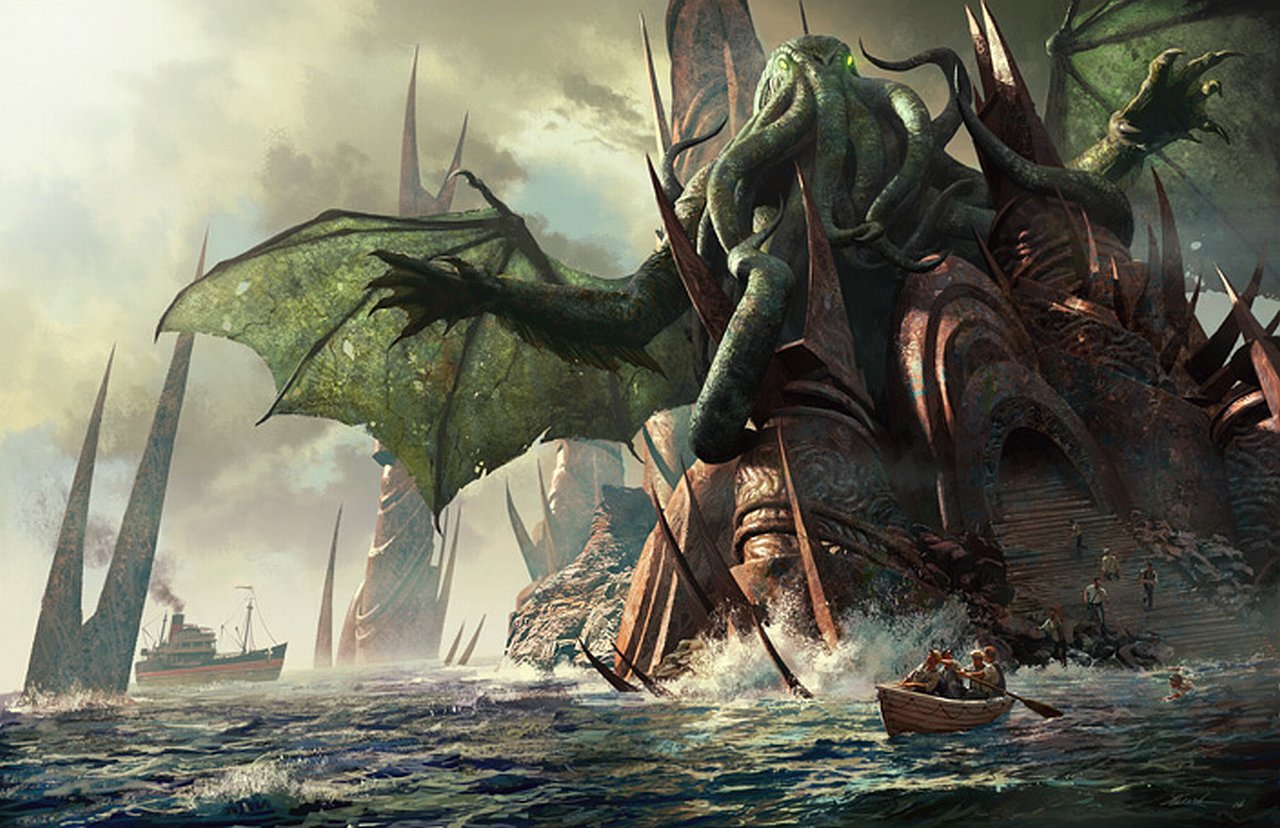
 As best I can tell, sometime after the Beginning, the Deep Ones had a falling out an one of their number, Cthulhu, came to earth to claim it as his own. Unfortunately, the stars were not right, so Cthulhu sunk his city-tomb to wait out the eons. Around this time his cousin Dagon also came to earth and settled in the sea.
Some time after this, the Forerunners arrived, populating the galaxy from some unknown place of origin. They loved Earth above all their possessions, and when the Flood came along, made plans to allow the humans to inherit their vast knowledge. It was a good thought, since the Flood proved too much for the orderly Forerunners, who disappeared into their shield worlds and touched off the Halo rings, exterminating the Flood.

Though future investigations turned up nothing, in fact the Forerunners had discovered a way to break through the barriers of space and time, stumbling into another dimension in the distant future. There, bereft of their technology, they set up a tribal existence so basic that the Imperium of Man, just arriving to explore the region, dismissed the newcomers as an indigenous species. In time the Forerunners, rediscovering their discarded technology, rose up to create a new empire, calling themselves the Tau and attributing their technological leap to their faith in “the Greater Good.” Unfortunately, the Forerunners/Tau had been followed by their Flood adversaries, who had fallen into the new reality at a different place and time. Mutating and reforming, the new Flood fleets descended upon the galaxy with new forms that were termed by the Imperium, “Tyranids.”
Meanwhile, back on Earth, the reseeding of the Human race went well and three principal races had formed: the Atlantians, the Lemurians, and the Picts. But at the start of the Hyborian Age a cataclysm shook the world and the first two empires collapsed, the survivors spreading out to form sundry new nations of Hyrkanians, Hyborians, Picts, and the tribes of the south. It was during this time that the Deeps Ones began to creep back into memory, for a legend grew that either in that age or the one previous, the followers of Bokrug the water lizard, the forgotten lords of Ib, had overthrown the city of Sarnath beside their acrid lake. Lost cities and temples dedicated to grotesque gods were occasionally discovered in pools and forests or hidden in the distant horizons, and in the tiny realm of Khauran, a great toad-like monstrosity called Thaug was installed by the witch Salome as a voracious puppet-deity. Thaug was perhaps the most visible of these dark religions, for he met his end when an invading army of Zuagirs, under the command of a Cimmerian named Conan, stormed the temple on behalf of a deposed queen. In time, the Picts came to rule the known world under their brutish king, Gorm.
Further cataclysms brought an end to the Hyborian Age and reshaped the landscape. This most destructive event also had the curious side effect of spinning off multiple realities, one of which would come to play host to the Forerunners/Tau and the Flood/Tyranids.
As for Earth, the nations of the world realigned themselves and history progressed largely as we have always believed. In the north of the Americas, a great nation called Lomar rose up to rival that of the Inca and Aztec and Maya, but fell with its capital city, Olathoë, to a wild tribe called the Inutos, later “Esquimaux,” who left no trace of the proud civilization. By the 19th Century, the enduring tales of Cthulhu were dismissed as the ravings of madmen, though a sailor claimed to have stumbled upon the alien’s city-tomb and encountered the nightmarish beast in person. The claim remains unverified.

All materials are not mine, but are collected from the fictions of H.P. Lovecraft, Robert E. Howard, Games-Workshop Ltd, and Bungie Studios
 As best I can tell, sometime after the Beginning, the Deep Ones had a falling out an one of their number, Cthulhu, came to earth to claim it as his own. Unfortunately, the stars were not right, so Cthulhu sunk his city-tomb to wait out the eons. Around this time his cousin Dagon also came to earth and settled in the sea.
Some time after this, the Forerunners arrived, populating the galaxy from some unknown place of origin. They loved Earth above all their possessions, and when the Flood came along, made plans to allow the humans to inherit their vast knowledge. It was a good thought, since the Flood proved too much for the orderly Forerunners, who disappeared into their shield worlds and touched off the Halo rings, exterminating the Flood.

Though future investigations turned up nothing, in fact the Forerunners had discovered a way to break through the barriers of space and time, stumbling into another dimension in the distant future.
 There, bereft of their technology, they set up a tribal existence so basic that the Imperium of Man, just arriving to explore the region, dismissed the newcomers as an indigenous species. In time the Forerunners, rediscovering their discarded technology, rose up to create a new empire, calling themselves the Tau and attributing their technological leap to their faith in “the Greater Good.” Unfortunately, the Forerunners/Tau had been followed by their Flood adversaries, who had fallen into the new reality at a different place and time. Mutating and reforming, the new Flood fleets descended upon the galaxy with new forms that were termed by the Imperium, “Tyranids.”
Meanwhile, back on Earth, the reseeding of the Human race went well and three principal races had formed: the Atlantians, the Lemurians, and the Picts. But at the start of the Hyborian Age a cataclysm shook the world and the first two empires collapsed, the survivors spreading out to form sundry new nations of Hyrkanians, Hyborians, Picts, and the tribes of the south. It was during this time that the Deeps Ones began to creep back into memory, for a legend grew that either in that age or the one previous, the followers of Bokrug the water lizard, the forgotten lords of Ib, had overthrown the city of Sarnath beside their acrid lake.
 Lost cities and temples dedicated to grotesque gods were occasionally discovered in pools and forests or hidden in the distant horizons, and in the tiny realm of Khauran, a great toad-like monstrosity called Thaug was installed by the witch Salome as a voracious puppet-deity. Thaug was perhaps the most visible of these dark religions, for he met his end when an invading army of Zuagirs, under the command of a Cimmerian named Conan, stormed the temple on behalf of a deposed queen. In time, the Picts came to rule the known world under their brutish king, Gorm.
Further cataclysms brought an end to the Hyborian Age and reshaped the landscape. This most destructive event also had the curious side effect of spinning off multiple realities, one of which would come to play host to the Forerunners/Tau and the Flood/Tyranids.
As for Earth, the nations of the world realigned themselves and history progressed largely as we have always believed. In the north of the Americas, a great nation called Lomar rose up to rival that of the Inca and Aztec and Maya, but fell with its capital city, Olathoë, to a wild tribe called the Inutos, later “Esquimaux,” who left no trace of the proud civilization. By the 19th Century, the enduring tales of Cthulhu were dismissed as the ravings of madmen, though a sailor claimed to have stumbled upon the alien’s city-tomb and encountered the nightmarish beast in person. The claim remains unverified.
All materials are not mine, but are collected from the fictions of H.P. Lovecraft, Robert E. Howard, Games-Workshop Ltd, and Bungie Studios
Tuesday, August 9, 2011
Witness Works - 2 - Rather Lost

This is inspired by a true story. My sister and I really did get ditched in Flash when our bus driver had specifically agreed to let us off in Upper Hulme, Derbyshire.
Saturday, July 16, 2011
Witness Works - 1

While going through some old notebooks I realized that I have left a great many characters floating aimlessly without a story to call home. So I've set up this comic to give them just that. While I will try to make clear when I am using a "guest character" from someone else's work, most of the figures here will be my own...or that's the plan!
Sunday, March 7, 2010
Pokemon and Clothes
Someone posed a question today: why do some Pokemon wear clothes? I think we're addressing a biological/environmental/social concept here.
Some Pokemon's genetic material produces structures that may appear artificial but are simply a natural element (consider the markings on butterflies). Other Pokemon are conditioned by necessity to improve themselves through the adaptation of items found in their environment, while still others, either out of social acceptance or mere personal interest, acquire accouterments not natural to their person.
Biological example: perhaps the Meowth's and Persian's forehead "jewelry" is analogous to the pearls discovered in clams.
Blastoise is a great example for environmental conditioning, as that particular species has discovered that cylindrical human refuse (pipes, tennis ball canisters, old potato cannons) is a superior conductor of the water ducts that occur naturally beneath the carapace.
As for social expectations, consider that prolonged exposure to humans has impressed upon the Machamp and Jinx the virtues of modesty, while the combat minded Primape discovered the advantages of training with weighted cuffs. Kadabra and Alakazam benefit from natural intelligence combined with remarkable psychic powers, and perhaps at some point in the past their ancestors discovered that the Spoon is a universally recognized icon representative of their abilities.
Some Pokemon's genetic material produces structures that may appear artificial but are simply a natural element (consider the markings on butterflies). Other Pokemon are conditioned by necessity to improve themselves through the adaptation of items found in their environment, while still others, either out of social acceptance or mere personal interest, acquire accouterments not natural to their person.
Biological example: perhaps the Meowth's and Persian's forehead "jewelry" is analogous to the pearls discovered in clams.
Blastoise is a great example for environmental conditioning, as that particular species has discovered that cylindrical human refuse (pipes, tennis ball canisters, old potato cannons) is a superior conductor of the water ducts that occur naturally beneath the carapace.
As for social expectations, consider that prolonged exposure to humans has impressed upon the Machamp and Jinx the virtues of modesty, while the combat minded Primape discovered the advantages of training with weighted cuffs. Kadabra and Alakazam benefit from natural intelligence combined with remarkable psychic powers, and perhaps at some point in the past their ancestors discovered that the Spoon is a universally recognized icon representative of their abilities.
Subscribe to:
Posts (Atom)